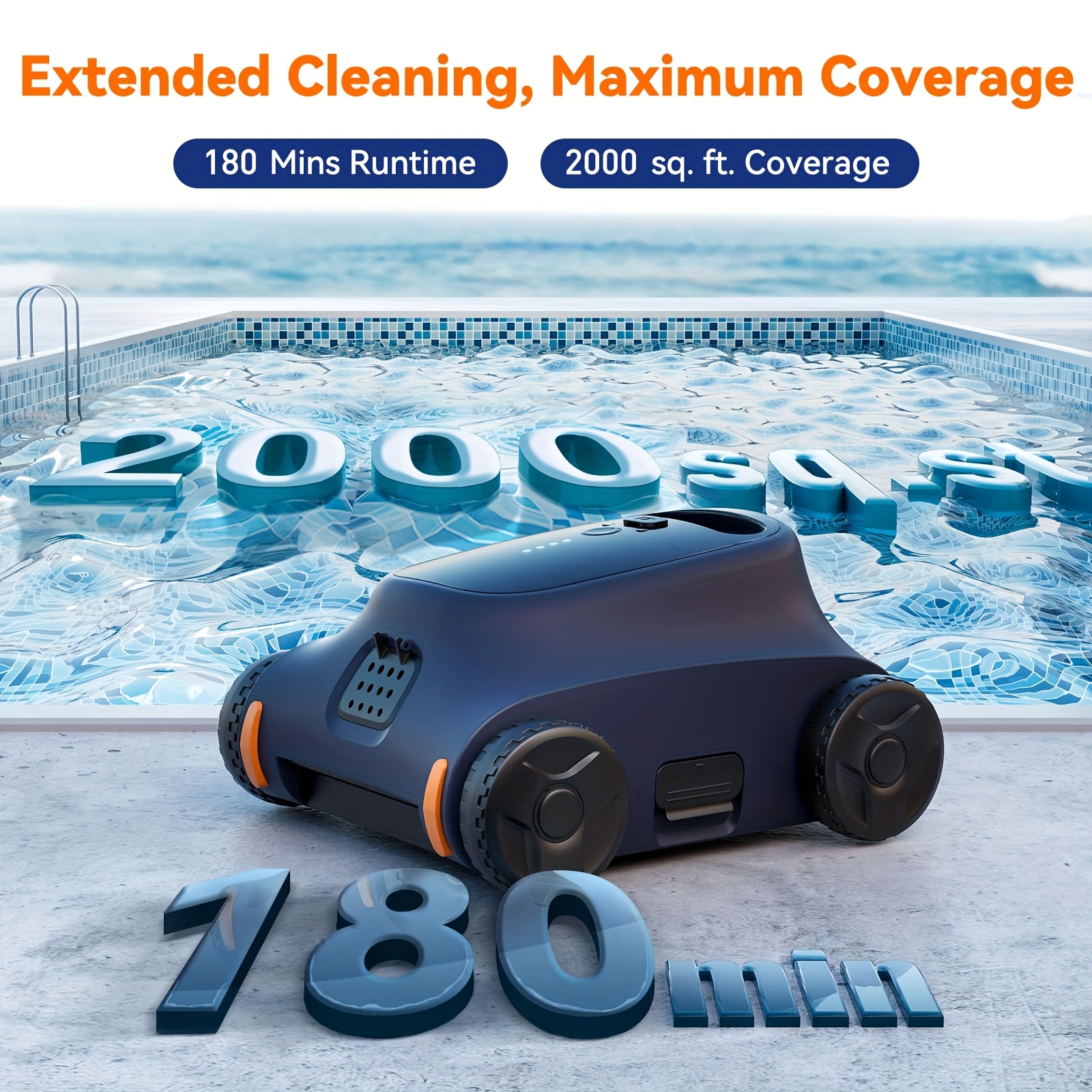
When researching robotic pool cleaners, the core of the matter lies in its cleaning performance and filtration system. The equipment should be capable of doing more than simply circulate around the pool. It should be able to actively remove toxins and ensure that the water is clean. Understanding the subtleties of how different robots accomplish this will let you choose a model that solves your particular debris issues, ensuring you get the sparkling results you expect.
1. The Cleaning Trinity.
The key to understanding effective cleaning involves three parts. The first step is to agitate the brushes and loosen debris from the surface. Then, the debris needs to be immediately pulled to the collection device with the force of a vacuum. Thirdly, the filtration process should be able to hold and contain the debris to ensure that it is not recirculated into the pool. If any of these components are weak the performance of cleaning will be poor. A robot that has strong brushes but poor suction can leave behind algae. One with great brushes but poor filtering will stir up dirt.
2. Brush Types: Their Particular Applications
Brushes are robots' tools to get rid of dirt. They must be made of a material that is both effective and safe for surfaces.
Stiff Bristle Brushes in Nylon: They are used to scrub and clean of hard surfaces like gunite (concrete), pebbles, and gunite. These brushes are essential to remove algae embedded in the surface and biofilm that adhere to rough plaster. These can scratch and wear vinyl liners over time.
Rubberized or soft/rubberized brush made of vinyl are the standard for vinyl liner, fiberglass pools and other pools with surfaces. These brushes offer excellent scrubbing without damaging the surface. They are also safe for softer surfaces. They are effective at loosening ordinary dirt and sediment, without the risk of.
Brushless Roller Systems: Newer technology is used in the most advanced models. Instead of rotating the rollers they utilize brushes to direct debris towards the suction. These brushes are very efficient for all kinds of swimming pools, and they can help reduce the wear and tear that rotating brushes can result in.
3. It is important to utilize a top-loading canister.
This is perhaps the most crucial feature to ensure user-friendliness. Top loading designs let you remove cartridges or bag filters from the robot's top after removing it from your pool. This prevents the large filters filled with dirt from falling down the bottom of the robot and splashing dirt on the deck or in the pool. Maintenance is simple using this system.
4. From Basic to Advanced, you can filter the types of media.
The size of particles the robot can capture is determined by the type of filter.
Standard Mesh Bags (common in older models and in simpler styles): These bags are made of standard mesh. They are suitable for catching larger debris, such as leaves and twigs. However, they can also be used to remove finer dirt and dust back to the water.
Pleated Cartridges (e.g. Dolphin's "Ultra-Fine"): This is the most prestigious of robotic pool cleaners. These cartridges offer a huge surface area that can trap particles smaller than 2 microns. This degree of filtration contributes greatly to the "sparkling" water clarity that top-end robots are renowned for. Filters are generally reusable.
Fine Micron Mesh Cartridges are a viable alternative to pleated papers. High-quality micron mesh cartridges can achieve a filtration level equivalent to that of paper. They are also more durable over the long run, although they might require more thorough cleaning.
5. Filter Systems for Specific Types of Debris
Many robots provide multiple filter options for different tasks.
Large Debris Bags/Cages: An open-weave bag or cage made of plastic is usually provided during large leaf fall. It lets water flow freely through while capturing a large volume of large debris.
Fine Filter Cartridges The purpose of these cartridges is periodic maintenance cleaning, focusing on the fine dust and sand which makes water look dull.
This feature is crucial for pools that are exposed to various kinds of debris throughout the year.
6. Suction Power & Water Flow Rates
The power of the pump is the main factor to determining the quality of the product. Manufacturers rarely provide detailed specs. The stronger suction will allow the robot to be able to lift heavier debris, such as sand (which is dense) and to remove the debris out of the water column more efficiently. It is used in conjunction with the brushes. The strong suction makes sure that the loose debris is immediately removed.
7. Active Brush Systems vs. Passive.
This is the way that brushes get powered.
Active Brushes - The robot's motor directs the brushes. This results in a strong, constant scrubbing motion regardless of the speed of the robot. This is a highly effective system that can be used to get rid of algae off walls.
Passive brushes: These brushes do not have power and are rotated only when a robot moves across the surface. The agitation is somewhat sporadic, but is not as effective at scrubbing as a motorized system.
8. Wall and Waterline Cleaning Technology
There are many robots that do not clean the walls in the same manner. Basic models might be capable of climbing the wall briefly. Advanced models use several techniques:
Boost Mode. The robot automatically increases suction force and/or brush speed in the event that it spots its position on the horizontal side of the surface. It ensures it does not slip and receives a thorough scrub.
Oscillating brushes: Certain models come with brushes that rotate at various speeds on walls to provide the best cleaning.
Waterline Scrubbing - The best robots will perform a focused scrub at the waterline in order to remove oily scum.
9. Cleaning Cycle Patterns.
The filtering system works when the robot can remove debris from its route. Navigation is a part of performance.
Random Patterns: Inefficient and may miss spots (especially complex pools). It takes longer to complete the pool.
Smart Patterns that are Systematic (Grid Scan and Gyroscopic) These patterns will ensure the robot covers the entire surface of the pool as efficiently possible. This ensures that the pool's filtration system is able to clean it.
10. The Relationship Between Primary Pool Filtration and Robotic Filtration.
The robotic cleaner is best seen as a kind of supplementary cleaner. It is able to clean all surfaces of the pool (floor, wall, waterline) and also filters out debris into a self-contained container or bag. It helps reduce the load on your pool's main pump and filter system. The main filter still filters the dissolved particles, and also moves chemicals. A robot isn't meant to take over the primary filtration system, but it works in conjunction with it. Take a look at the most popular pool cleaning tips for site tips including in your pool, pool cleaning how to, robotic pool cleaners on sale, cleanest pool, any pool, swimming pool service companies, aiper pool robot, in the swimming pool, swimming pool automatic vacuum, cleanest pool and more.

Top 10 Tips For Improving The Energy Efficiency Of Robotic Pool Cleaners
It is essential to know the source of power and energy efficiency when evaluating robot cleaners. This will impact the overall cost of operation as well as the impact on the environment of your pool as well as the ease of use. Robotic cleaners do not rely on the pump in the pool which is an enormous energy consumer. They run independently using their own high-efficiency, low-voltage motor. Their greatest advantage is the fundamental differences. They are able to save huge sums of energy. Not all robots, however, are the same. When you look into the specifics regarding their power consumption patterns and requirements for infrastructure and infrastructure requirements, it can help you select a robot that has the best performance for the least cost.
1. The Main Advantage: Independent Operation at Low Voltage.
It's the basic idea. Robotic cleaners have their own motor and pump which is powered by a transformer connected to an ordinary GFCI plug. It operates using a low voltage DC voltage (e.g. 24, 32 V), making it more reliable and safe to operate than a 1.5 or 2.5 HP main pool pump. This freedom allows the operation of the robot with no needing to run your energy-intensive pool pump.
2. Watts vs. Horsepower. Horsepower.
Knowing the size is crucial in order to realize the savings. The main pumps in a pool draw between 1500 and 2,500 watts in an hour. However, the cleaning cycle of an advanced robotic pool cleaner uses between 150 to 300 Watts per hour. This is a 90% energy saving. A robot operating for three hours uses about the same amount of energy that a few lightbulbs require for the same duration instead of the main pumps, which consume a lot of energy like large appliances.
3. The DC Power Supply/Transformer: Its crucial role
The black device between your outlet cable and the robot's power cable isn't just a simple power plug but also an intelligent transformer. It converts 110/120V AC to DC power to the robot. The quality of this component is crucial to the robot's efficiency and safety. It also includes the control circuitry needed to program the cycles.
4. Smart Programming for Improved Efficiency.
The programming of the robot influences its energy usage. Efficiency is enhanced through the capability to select particular cleaning cycles.
Quick Clean/Floors Only Mode In this cycle, the robot is run for less time (e.g. approximately 1 hour) using an algorithm that is just cleaning floors. This mode consumes less energy compared to a full cycle.
Full Clean Mode: A standard 2.5 to 3 hour cycle to complete cleaning.
You should only run your machine for as long as you require it to complete the job.
5. Impact of Navigation of Energy Consumption.
The cleaning path of an automated robot has a direct connection to the amount of energy used. A robot that is based on random navigation (bump and turns) is not efficient. It could take hours to cover the entire pool. A robot with systematic, gyroscopically-guided navigation cleans the pool in a methodical grid pattern, completing the job in a shorter, predictable timeframe (e.g., 2.5 hours), thereby using less total energy.
6. GFCI Outlet Placement and Requirement.
To ensure absolute security the power source of the robot MUST be plugged into a Ground Fault Circuit Interrupter (GFCI) outlet. These outlets have "Test" and "Reset" buttons that are commonly found in bathrooms and kitchens. If your pool does not have an GFCI outlet, it should be set up by a licensed electrician before cleaning the pool. The transformer must be at least 10 feet from the edge of the pool to keep it safe from water splashes or the elements.
7. Cable Lengths and Voltage Falls
In very long distances "voltage loss" could occur in low-voltage cable. Manufacturers set a limit to the length of the cable (usually 50-60 feet). Excessing this length could result in a lack of power reaching the robot, leading to poor performance, slow movement and a lower climbing capability. Check that the cable on the robot is long enough to allow it to reach the farthest point of your pool from the outlet. However, do not use an extension cord as it could increase voltage drops, and result in an issue with safety.
8. Comparing Efficiency with Other Cleaner Types
To ensure that the cost of the robot can be justified, it's essential to know what you're comparing him with.
Suction-Side Cleaners: These rely entirely on your main pump for suction. These cleaners require you to operate your pump for 6-8 hours daily, which results in very expensive energy bills.
Pressure-Side Cleaners: These use your main pump to produce pressure. Typically, they come with a booster pump that adds another 1-1.5 HP of energy draw.
The robots' efficiency as an independent option makes them a cost-effective choice over the long run.
9. Calculating Operating Costs
It is possible to estimate the cost of operating your robot. This formula is: Electricity Cost ($/kWh) (Watts/1000) x (Watts/1000) Hours used.
Example: A 200-watt robot employed for 3 hours three times per week with electricity costing $0.15 per kWh.
(200W / 1000) = 0.2 kW. 0.2 kW x 9 hours per week equals 1.8 Kilowatts. 1.8 Kilowatts multiplied by $0.15 equals $0.27 per week or $14 annually.
10. Energy Efficiency As A Marker Of Quality
Generally speaking, advanced motor technology and efficiency go hand-in-hand with better quality products. A high-quality robot that can provide cleaning capability in a shorter duration, and using less power, is typically an indication that the design and navigation software is better, as well as a pumping system that is more efficient. The higher the wattage of the motor, the more powerful it is for climbing and sucking. However, what defines effectiveness is a machine that efficiently cleans in a short period of time and with less power. A model that's efficient and well-designed can save you cash on your energy bills for a long time. Take a look at the top saugroboter pool akku for site tips including aiper pool, robotic pool cleaner, waterline pool, smart swimming pool, swimming pool automatic vacuum, swimming pool robot cleaner, robot for the pool, robot to clean the pool, max pools, pool website and more.